
Programme · Resilience
Resilience is a skill that can be learned.
A playful, research-informed wellbeing & resilience curriculum for pre-teens (9–11) — usable in schools, at home with families, and in clinics as add-on material.

Why this works
Three resilience markers, one protective shift.
Personalisation
Children learn to see setbacks as situations — not as identity. The story of self stays intact.
Pervasiveness
A bad moment stays a bad moment. It does not become a bad day, a bad week, a bad life.
Permanence
Difficulty is a season, not a forecast. Hope becomes a learnable cognitive skill.
6 Lessons · 6 Superpowers
Core skills for school & life.
What children take with them after the programme — in their own words.
The inner voice
"The voice in my head affects how I feel — and I can change it."
Naming feelings
"When I name my feelings, they don't feel so big anymore."
Catching exaggeration
"When my thoughts are exaggerating, I can detect it and think more clearly."
Investigating thoughts
"I don't believe every thought right away — I investigate it."
Shrinking worries
"I can make worries smaller and see the whole picture."
Real life
"I can use my superpowers when real life gets tricky."
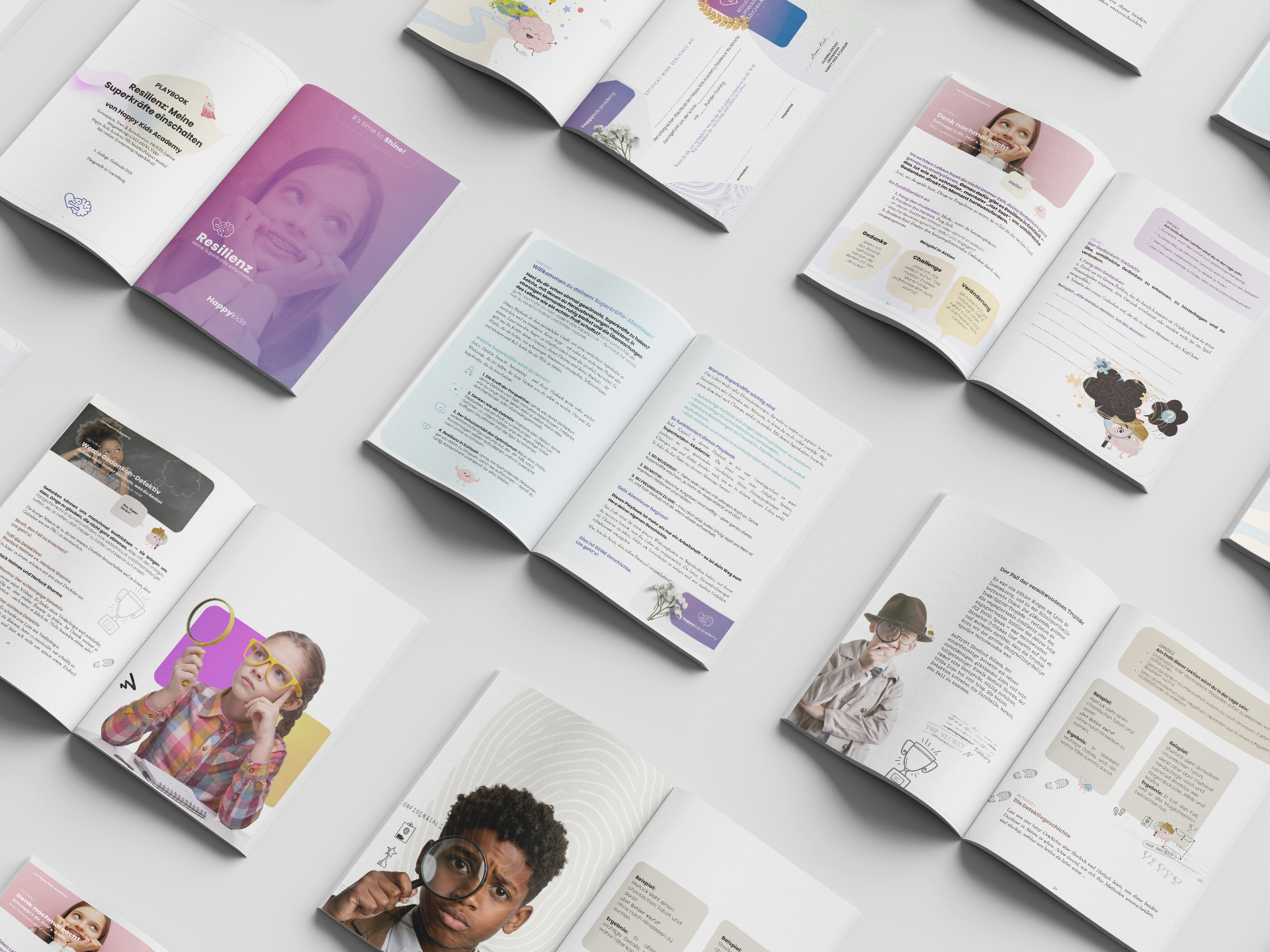
Resilience, made tangible.
Where it's used
Three settings, one shared language.

Curriculum alignments
“Depression” should not be a word teenagers grow up with.
Universal facts on top. Luxembourg curriculum alignment lives in the expandable below; full programme details open by default underneath.
- What it is
- A playful, research-informed wellbeing & resilience curriculum for pre-teens aged 9–12. Built on the Penn Resilience Programme and adapted for multilingual European schools, it teaches children to read setbacks accurately — keeping a bad moment a bad moment, not a bad week or a bad life. Usable in schools, at home with families, and in clinics as add-on material.
- Learning objectives
- Understand that the voice in my head shapes how I feel — and I can change it.
- Name feelings to make them smaller and more workable.
- Detect exaggerated thoughts and reframe them clearly.
- Investigate thoughts before believing them.
- Shrink worries by seeing the whole picture.
- Apply the six superpowers when real life gets tricky.
- Domain
- Core Entrepreneurship (life-skill foundation)Sustainability (mental sustainability)Career & study orientation
- UN SDGs
- SDG 3Good Health & Well-beingSDG 4Quality Education
- YouthStart Challenges
- Hero Challenge (A2)My Personal Challenge (A2)
- CASEL SEL Competencies
- Self-AwarenessSelf-Management
- OECD Learning Compass 2030
- Taking ResponsibilityStudent Agency
- Luxembourg Education Priorities
- Mental Health PromotionPersonal DevelopmentPreventionWellbeing
- 21st-century skills
- #Critical thinking#Adaptability#Persistence#Problem-solving#Initiative#Communication
- Location
- In schoolAt home (family use)In clinics (add-on material)
- Partners & funding
Luxembourg Public Schools: Available your public schools through the Extraklass.lu platform.
Supported financially by: André Losch Fondation.
Evidence & framework
Measured against the Resilience Impact Curve.
A proprietary hybrid impact assessment from Happy Kids Academy — we track the impact curve of each child's resilience markers across the programme, not a one-off survey. Schools can opt in to formal testing; parents can request the home version.

- Pre / mid / post resilience-marker mapping per student
- Resilience Impact Curve — proprietary hybrid assessment
- Optional school testing track with classroom dashboards
- Optional parent testing track for at-home follow-through
- Train-the-trainer pathway for school autonomy
Onboard the program.
We're connecting with like-minded schools, professionals and families to amplify the impact. Sign up below or write to hello@happy-kids.lu.
Continue exploring